
When we hear news about the Strait of Hormuz, the assumption is often simple: once shipping lanes reopen, things go back to normal.
In reality, the recovery process is much more complex. And this is especially true for the specialty chemicals used in epoxy and polyurethane systems.
At Copps Industries, we’ve been closely monitoring the ongoing disruptions impacting the global chemical market. The headlines often focus on oil tankers and crude supply, but for specialty chemical manufacturers, crude oil is only the beginning. What’s really important is what happens after those materials leave the tanker.
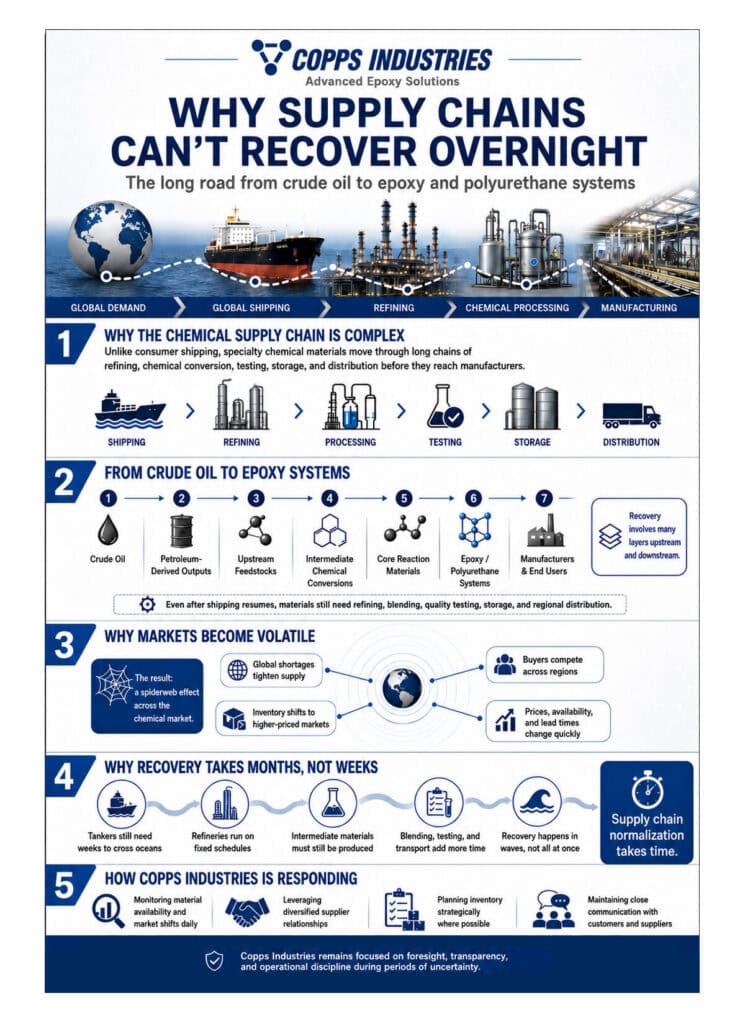
Why Chemical Supply Chains Are So Complex
Modern supply chains have conditioned us to expect speed. When you place an order online today, a package often arrives on your doorstep tomorrow. That kind of convenience has made logistics feel easy and seamless.
But the industrial supply chain operates differently. The materials used to manufacture epoxy and polyurethane systems move through a long chain of chemical conversions, transportation steps, and processing stages before they reach a formulation facility—and none of those steps happen quickly.
The Long Journey from Crude Oil to End Users
Let’s trace the hypothetical journey of an oil tanker trapped in the Persian Gulf.
Even if the shipping corridor reopened today, the tanker’s cargo would take weeks to reach end users. The process looks something like this:
- Tankers move slowly, often around 10–15 knots
- After leaving the Gulf, shipments may take weeks to reach major refining regions
- Unloading alone can take several days
- The refining process takes additional time
- Materials then undergo blending, quality testing, storage, and regional distribution before they ultimately reach manufacturers
And this is only the oil side of the equation. For specialty chemical manufacturers, there are many more steps ahead.
The Long Bridge Between Crude Oil and Epoxy/PU Systems
One of the biggest misconceptions in the market right now is the belief that reopening shipping lanes in the Strait of Hormuz would immediately restore material availability. But epoxy and polyurethane aren’t loaded directly onto tankers. The raw materials that eventually become these systems begin several layers upstream.
A simplified view of the epoxy resin supply chain looks like this:
- Crude material →
- Multiple petroleum-derived outputs →
- Numerous upstream feedstocks →
- Several intermediate chemical conversions →
- Multiple core reaction materials before a final epoxy resin is produced
Polyether polyols used in polyurethane chemistry follow a similarly complex path.
When disruptions occur at the crude oil level, the effects ripple downstream through a network of interconnected chemical processes. Each step adds layers of complexity and time.
Why Supply Markets Become Volatile
As global supply tightens, purchasing behavior changes. Regions that normally source materials locally begin competing internationally, prompting suppliers to redirect inventory toward the highest-demand or highest-priced markets. This creates a “spiderweb effect,” which explains the volatility in once-predictable supply patterns.
For example, a domestic supplier may normally prioritize U.S. customers. But if overseas buyers are willing to pay significantly more, inventory may shift internationally. That reduces domestic availability, causing domestic prices to rise in response.
At the same time, some materials remain physically stranded in global shipping bottlenecks, further limiting access. The result is a market where availability changes quickly, lead times become difficult to predict, and pricing fluctuates rapidly.
These complications make procurement more complex for everyone.
Why Recovery Will Take Months, Not Weeks
Even under favorable conditions, global chemical supply chains can’t restart instantly. The infrastructure itself limits how quickly materials can move:
- Tankers still need weeks to cross oceans
- Refineries operate on fixed production schedules
- Intermediate materials must still be manufactured and converted
- Storage, blending, testing, and transportation all take time
And because hundreds of tankers remain delayed, recovery is likely to happen in waves, not all at once.
Historically, chemical markets also tend to feel disruption earlier—and remain affected longer—than some other industries. We experienced this firsthand during the pandemic-era supply chain crisis, when recovery across the chemical market extended well beyond the initial disruptions.
The lesson we learned then will almost certainly apply now: supply chain normalization takes time, and, unfortunately, nothing can be done to speed it up.
How Copps Industries is Navigating the Disruption
While market conditions remain uncertain, Copps Industries continues to focus on proactive communication and taking steps for long-term stability. That includes:
- Monitoring material availability and market shifts daily
- Leveraging diversified supplier relationships across global regions
- Planning inventory strategically where possible
- Maintaining close communication with customers and suppliers
For specialty chemical manufacturers, the path from crude oil to finished epoxy or polyurethane systems is long and complex. We understand that consistency matters during periods of uncertainty. That’s why Copps Industries remains focused on navigating the disruption with foresight, transparency, and the operational discipline our customers rely on.